
Lisbon - Travel guide to iconic attractions
Lisbon was love at first sight for me. I've been here several times, and it has never disappointed me, and I've even been lucky with the weather: although I always brought an umbrella, especially in November, the city still gave me wonderful sunshine most of the time.
Lisbon is a place that reveals a new face with every step: old and modern, calm and vibrant, romantic and creative. When exploring the Portuguese capital, it's worth taking time to explore both the historic districts and the modern cultural centers - and of course, the gastronomic experiences. You'll need comfortable shoes, as there are many steep streets, so walking can be a challenge for even the most fit travelers.
Alfama - the soul of Lisbon, where the past still lives today
It is worth starting your sightseeing tour in the Alfama district, which is the oldest and perhaps most authentic part of Lisbon. Its narrow, cobblestone streets, steep staircases and dazzling white houses invite you to travel back in time. Alfama is special because it is the only part of the city that survived the massive earthquake of 1755 almost intact, so the medieval city structure and atmosphere have been preserved to this day.
While wandering around the neighborhood, it's worth stopping at the Sé Cathedral, Lisbon's oldest church, and then walking up to the São Jorge Castle, from where you can enjoy breathtaking views of the Tagus River and the city's undulating rooftops.

Along the way, you will find the Miradouro de Santa Luzia lookout point, and almost opposite it you can see one of the famous Bordalo II works, the Panda. The streets of Alfama are often filled with fado, the soul music of the Portuguese - in the evenings you can also find dinner accompanied by live music in many small restaurants. However, the real charm of the district lies in the simple everyday life: in the colorful tiles, the flowered windows, the drying clothes and the kind smiles of the locals.


From here, you can easily reach Rua Augusta, one of Lisbon's liveliest and most famous pedestrian streets, which runs through the heart of the Baixa district, with elegant classicist buildings, cozy cafes, shops and street musicians, creating a true Mediterranean urban atmosphere.


At the end of the street stands the imposing Arco da Rua Augusta, a triumphal arch commemorating the city's reconstruction after the great earthquake of 1755, and offering breathtaking views of the Tagus River and the city. Beneath the triumphal arch is the vast, elegant Praça do Comércio, one of Lisbon's most beautiful main squares, surrounded on three sides by yellow arcaded palaces and with an equestrian statue of King José I in the middle, which is now one of the city's most important meeting places.


There is also a special sardine shop nearby: Loja das Conservas, which I think is worth visiting.
Portuguese canned sardines are a true delicacy, famous all over the world for their authentic, rich taste. Fresh sardines from the Atlantic Ocean are carefully cleaned and then preserved in olive oil or their own juice, thereby preserving the natural flavor and texture of the fish. Canned sardines are not only practical and have a long shelf life, but can also be used in many ways: on bread, in salads, in pasta or simply on their own, they are the perfect quick and healthy meal. Portuguese canned sardines are a true culinary experience that brings traditional Portuguese flavors. You can get a taster in the store, making it easier to choose from the otherwise huge selection. Sardine boxes are also perfect as a souvenir or gift, because their packaging is really special.


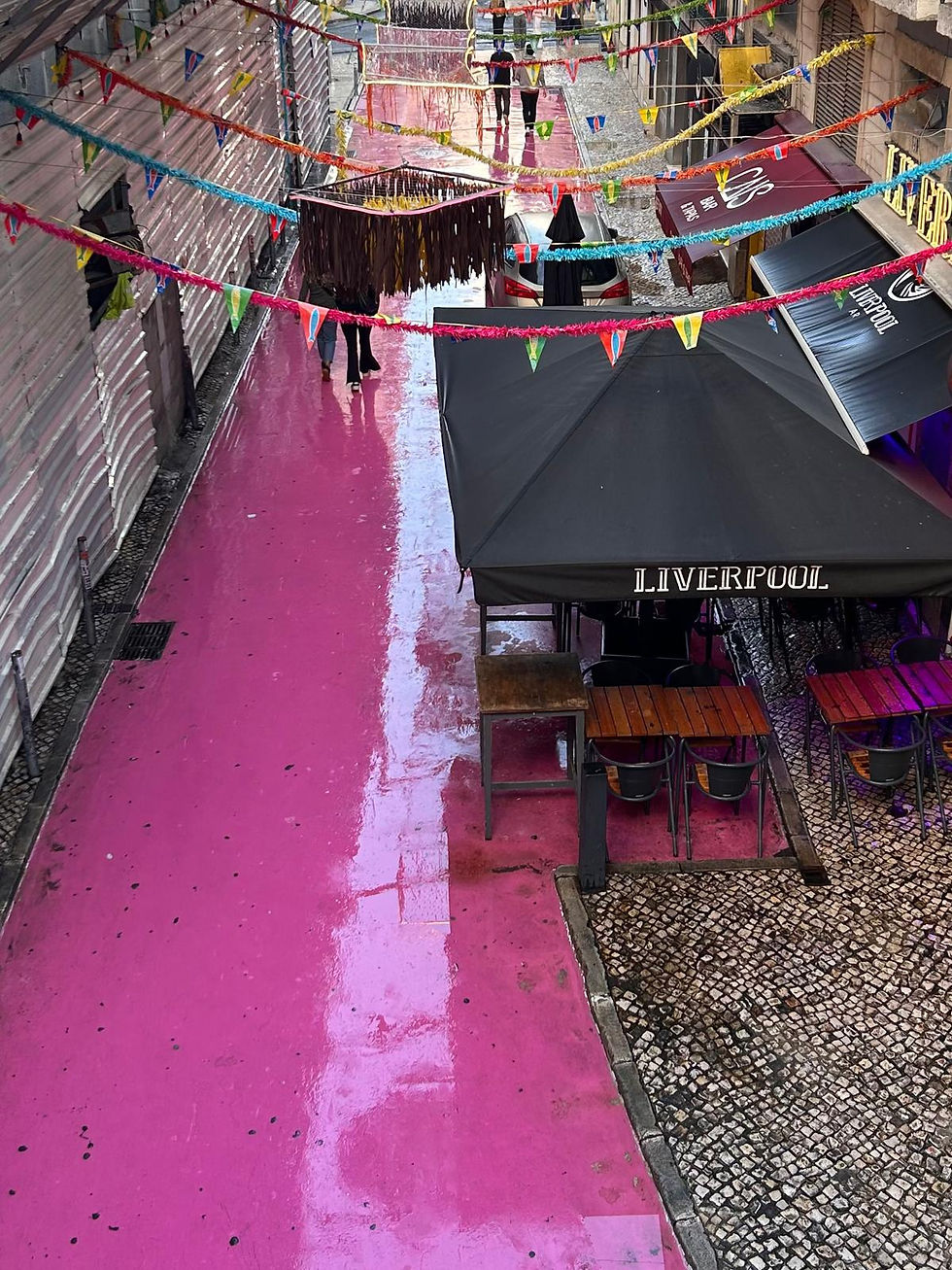
Pink Street (officially Rua Nova do Carvalho) is a short walk away: this unique attraction is located in Lisbon's former red-light district, Cais do Sodré, and has become world-famous for its distinctive pink pavement. The street was painted bright pink in 2011 as part of an urban renewal project aimed at making the previously run-down area, known for its night clubs and seafood restaurants, safer and more attractive to young people and tourists. Today, it's one of Lisbon's most popular photo spots, filled with stylish bars, clubs and street art, as well as the iconic colorful umbrellas, making it particularly photogenic - a cozy city landmark by day and a vibrant party spot by night.



Chiado - the elegant district of artists and cafes
After the romantic Alfama, Chiado, Lisbon's art and shopping district, offers a completely different atmosphere. Here, cafes, historic shops and theaters line up side by side. The statue of Fernando Pessoa in front of the famous A Brasileira Café is an almost obligatory photo spot, and the cozy streets are ideal for relaxing with a cookie and a cup of strong Portuguese coffee.


Here you will find the world's oldest operating bookstore, Livraria Bertrand, which is worth shopping at, if only because you will receive a special stamp in your book!

From here, the Elevador de Santa Justa is very close, One of Lisbon's most famous neo-Gothic monuments, inaugurated in 1902 and originally built to bridge the steep level difference between the Baixa and Chiado/Carmo districts. Interestingly, it was originally powered by a steam engine. The wrought-iron, richly decorated elevator was designed by Raoul Mesnier du Ponsard and bears the influence of Gustave Eiffel's school, which is why many people refer to it as the "Lisbon Eiffel Elevator". The more than 45-meter-high structure is not only a means of transport, but also a lookout: from its upper terrace, there is a stunning panorama of the rooftops of Baixa, the Castelo de São Jorge citadel and the Tagus River, making it one of the most popular photo spots in the city. Next to the elevator, you can also see the pelicans of Bordalo II.


Just a few steps away is the Convento do Carmo (Carmo Convent), one of Lisbon's most unique historical monuments, which was severely damaged in the great earthquake of 1755 and was never fully rebuilt, so it can now be seen as a romantic, open-air ruin church. Founded in the 14th century, the Gothic monastery was one of the city's most important religious centers, and today it houses the Carmo Archaeological Museum, where you can see medieval tombstones, sculptures, mosaics and archaeological finds. The soaring, roofless arches create a special atmosphere and spectacularly show the power of the natural disaster and one of the most dramatic chapters in Lisbon's history. There is also a very interesting projection inside the exhibition, which presents the history of the monastery.


From here, heading northeast, we reach Parque Eduardo VII, one of Lisbon's largest and most beautiful city parks, stretching from Marquês de Pombal Square to Amália Rodrigues Garden, offering stunning views of the Tagus River, the Baixa district and the city's historic center. The park's neat, geometric walkways and flower beds are ideal for a leisurely stroll or picnic, while the higher parts offer perfect views of Lisbon's iconic cityscape. The park is also a cultural space: here you can find the Estufa Fria, a greenhouse where you can take a walk among exotic plants.


It is also worth seeing the statue of the Marquis of Pombal, located in Praça do Marquês de Pombal: one of the city's most important transport hubs. The statue stands atop a tall column and is located at the lower end of Parque Eduardo VII, at the northern end of Avenida da Liberdade.
The monumental monument pays tribute to Sebastião José de Carvalho e Melo, known as the Marquis of Pombal, who led the city's reconstruction.
LX Factory - Lisbon's creative hub
LX Factory is one of the most exciting and trendy parts of Lisbon, reborn on the site of an old industrial complex under the 25 de Abril bridge. The former textile and printing factories are now filled with walls covered in street art, alternative fashion stores, design shops, art galleries and unique cafes. The area functions as a true creative community space, where the best of modern Lisbon art is concentrated.


One of the most iconic places is the Ler Devagar bookstore, where the flying bicycle installation hanging from the ceiling and the floor-to-ceiling bookshelves give the place a magical atmosphere. This neighborhood is the perfect place for those who want to get to know the bohemian, youthful and alternative side of Lisbon.


Belém - memories of discoveries and the golden age
One of Lisbon's most beautiful neighborhoods is Belém, located on the banks of the Tagus River, a symbol of the Portuguese Age of Discovery. The colossal Monument to the Discoveries (Padrão dos Descobrimentos) is visible from afar, shaped like the prow of a ship and paying homage to Vasco da Gama, Magellan and other famous Portuguese explorers. The riverside promenade offers particularly impressive views.


The jewel of Belém, however, is undoubtedly the Jerónimos Monastery, one of the finest examples of late Gothic-Manueline architecture in Europe. The monastery took over 100 years to build and is now a UNESCO World Heritage Site. Its interior courtyard is a masterpiece, with its intricately detailed stone lacework and twisted columns, and the church also contains the tomb of Vasco da Gama. The atmosphere of the monastery is both grandiose and soothing - a place where it is easy to linger and soak up the richness of Portuguese history.


Belém is also home to the modern and spectacular Quake - Earthquake Museum, where you can relive the dramatic moments of the Lisbon earthquake of 1755 through interactive experiences. The exhibition not only provides a historical overview, but also uses simulations, multimedia elements and impressive installations to show how the disaster transformed the city and Portuguese society.
There are other museums in the area that are worth visiting on a rainy day: you can see beautiful old cars at the Museu National dos Coches, for example, but the MAAT (Museum of Art, Architecture and Technology) is also very special. Next to the monastery you will find the Maritime Museum.
The Belém Tower is currently being renovated (2025), so unfortunately it is not as exciting now, but it is otherwise an unmissable attraction in this part of the city.
Of course, exploring Lisbon wouldn’t be complete without visiting as many of its miradouros (iconic viewpoints), taking a scenic ride on tram 28, or going on a gastronomic adventure. Whether you’re admiring the city from a high-altitude observation deck at sunset or sampling freshly baked Pastéis de Belém in Belém, Lisbon will enchant you at every turn. The city’s diversity and unique atmosphere make it one of your favorite destinations.





Comments